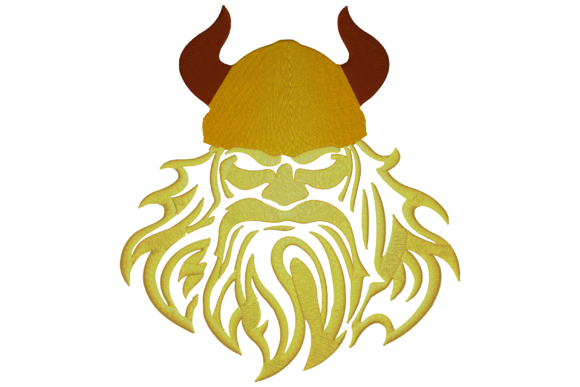
Face of Viking Warrior
A Designer’s First Look: Bold, Rugged, and Ready for Real Projects
As an embroidery designer who’s digitized over 400 original machine embroidery designs—and shipped thousands of custom apparel and home goods—I approached Face of Viking Warrior with both curiosity and caution. It’s not just another “cool graphic” in the Around The World category—it’s a character-driven embroidery file that demands presence. Visually, it carries a grounded intensity: strong jawline, weathered brow, braided beard, and subtle shading built into the stitch plan. With only three thread colors, the design avoids visual clutter while delivering texture and depth—especially in the beard and hair, where layered satin stitch and controlled fill stitch create movement without overcrowding.
Where This Embroidery File Naturally Fits
Face of Viking Warrior isn’t a background motif—it’s a statement. In real-world use, it shines on products where personality and craftsmanship intersect: men’s sweatshirts, unisex tote bags, aprons for craft breweries or artisanal kitchens, and pillow covers for Nordic-themed nurseries or cabin-style living rooms. I tested a mid-size version (approx. 4.5”) on a heavyweight cotton twill tote and immediately noticed how well the facial contours held shape—even across slight fabric drape. It also translated beautifully to a baby blanket edge (scaled down to 3”), where the simplified features read clearly without looking aggressive or overly detailed for infant decor.
Performance Across Common Embroidery Surfaces
Real project success hinges on predictability—and Face of Viking Warrior delivers consistency across varied substrates, *if* you prep intentionally:
- Tote bags & aprons: Works cleanly on medium-weight canvas and duck cloth. Use medium-cutaway stabilizer to prevent puckering around the jawline and eyes—areas with tighter satin stitch transitions.
- Sweatshirts & crewnecks: Stitched cleanly on 80/20 cotton-poly blends with tear-away + light cutaway combo. Avoid heavy fleece backs unless you reduce density slightly—the design doesn’t need extra fill to read strongly.
- Caps & curved surfaces: The smallest available size (likely under 3”) is ideal here. Its clean outer outline and minimal interior detail make it far more cap-friendly than many portrait-style designs. Still—always test on a cap blank first; curvature distorts even well-digitized eyes and brows.
- Baby items & kitchen towels: Because it uses only three colors and avoids tiny lettering or micro-details, it’s wash-durable. No floating stitches or fragile runnings—just intentional satin and fill. That matters when your finished product goes into daily rotation.
- Embroidered patches: A natural fit. The defined edges and moderate stitch density mean clean heat-press or sew-on application without fraying or shadowing through lightweight backing.
What This Design Adds to Your Handmade Product
When customers buy handmade, they’re buying intention—not just utility. Face of Viking Warrior elevates perceived value by signaling thoughtful curation and skilled execution. On Etsy listings, it adds narrative weight: a Viking-themed kitchen towel becomes part of a cohesive story (“Norse Hearth Collection”), not just a one-off. For craft fairs or boutique consignment, it helps your booth stand out with recognizable, culturally resonant imagery—without leaning on overused clichés like axes or longships. And because it’s hand-digitized (not auto-traced), the stitch flow feels organic: no robotic repetition, no awkward jumps between features. That authenticity shows up in product photography—especially side-lit shots that catch the subtle dimension of the beard fill.
Practical Notes Before You Stitch
This isn’t a “load-and-go” file—and that’s a good thing. Its quality comes from attention to real-world variables. Here’s what I recommend before stitching Face of Viking Warrior into a customer order or inventory batch:
- Test on scrap fabric matching your final substrate—especially if using dark fabric. Three-color contrast can shift dramatically on navy or charcoal.
- Review stitch density in your embroidery software. While well-balanced overall, the beard area has higher fill concentration. On stretchy knits, consider reducing density 5–10% to avoid stiffness.
- Confirm hoop size for your chosen size variant. The six available sizes suggest flexibility—but don’t assume the largest will fit your standard 5×7 hoop without checking the actual dimensions listed on the Creative Fabrica page.
- Compare light/dark mockups using printable mockup templates. The design’s strength lies in silhouette and contour—so ensure those remain legible against your base color.
- Use appropriate stabilizer: medium cutaway for stable wovens, tear-away + topping for textured towels, and soft cutaway for baby blankets.
- Inspect small details post-stitch: eyelashes, beard strands, and brow texture are rendered with purpose—not decoration. If they disappear on your fabric, revisit tension and needle size.
- Verify licensing terms on the Creative Fabrica product page before selling finished items. As a commercial embroidery user, I always confirm whether the license permits unlimited physical products—and whether attribution is required.
Final Thoughts for Sellers and Makers
Face of Viking Warrior won’t suit every brand—but for makers building collections around heritage, resilience, or quiet strength, it’s a standout digital embroidery file. It avoids trend-chasing while feeling fresh next to generic tribal or nautical motifs. It works equally well as a solo focal point or as part of a curated set (think: Norse knotwork border + Face of Viking Warrior center). Most importantly, it behaves predictably across machines—from Brother Innov-is to Tajima multi-heads—because its digitizing prioritizes function alongside form. If you sell custom apparel, run a handmade shop, or source design assets for seasonal gift lines, this is one Creative Fabrica embroidery file worth evaluating not just for aesthetics, but for reliability, scalability, and storytelling power.